Why 21% Redesign Processes — and 79% Just Install Tools
In the previous article we reached an uncomfortable conclusion: almost every company already "uses" AI, but almost none captures value from it. And the differentiator that weighs most isn't budget or the tool — it's process redesign. McKinsey tested 25 organisational attributes, and this was the one with the biggest effect on EBIT impact. Yet only 21% of organisations have done it. The other 79% simply add AI to the process they already had.
The difference between the two is everything. Adding AI to a process means handing a new tool to a workflow designed for a world without that tool. Redesigning the process means asking: if this capability had existed from the start, how would the work be organised? BCG captures it in a ratio worth memorising: roughly 10% of AI's value comes from the algorithms, 20% from the technology and data, and about 70% from organisational transformation. The bulk of the value isn't in the model. It's in how the work is reorganised around it.
This article is about that 70%. It's the "how" that follows once you understand the "why" — the method, in five steps, for redesigning a process with AI, and where an SME should start.
Step 1 — Map the Process, Not the Tool
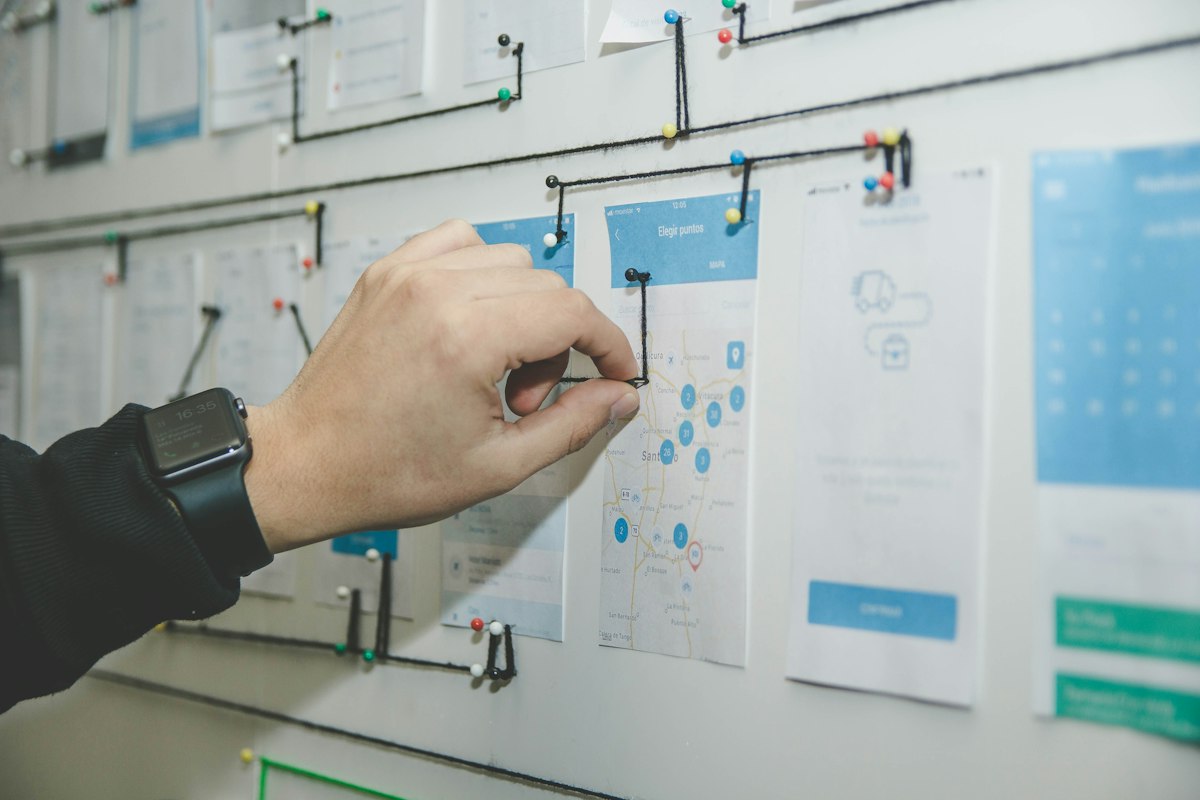
The most common mistake begins with the first decision: choosing the tool before understanding the process. The correct sequence is the reverse. Before any AI, you map the real end-to-end workflow — who does what, in what order, with which inputs, where it waits, where it gets reworked.
This map reveals two things no product demo reveals: where the team's time is lost and where output quality is most variable. That's where AI pays off — not where it's most impressive, but where the problem is most real. McKinsey is blunt on this: the transformations that work start from business outcomes, not features. You pick one process — just one — with high volume, frequent repetition, and a measurable outcome. Spreading AI across twenty processes at once is the recipe for changing none of them.
Step 2 — Separate Where AI Decides from Where Humans Judge
With the process mapped, the second decision is one of boundaries: in which steps can AI act, and in which steps must human judgement decide. This boundary is drawn on purpose, not by default.
The practical rule is the same one that governs human work: AI is reliable in stable, repeatable context, and unreliable when context shifts in ways nobody anticipated. An unusual client request, a regulatory exception, a decision that affects a long-term relationship — there, AI prepares and informs, but a person decides. Drawing this line before building avoids the two symmetrical failures: automating what needed judgement, and keeping manual what could already run on its own. This is human-in-the-loop by design — not the human-in-the-loop that happens by accident when no one thought about it.
Step 3 — Rebuild the Flow, Don't Bolt AI On Top
This is the step the 79% skip. Harvard Business Review describes successful redesign as a blank-sheet exercise: break the process into its tasks, rebuild those tasks into new steps — some for AI, some for people — and then train the team on the redesigned flow. It isn't pasting a chatbot over the old process. It's rebuilding the process assuming AI exists.
Let me give an example I know from the inside. **LusiberiaStays** — a short-term rental operation I run myself, and which is not a THE iCON client — had a guest-communication process like almost everyone in the sector: messages written by hand, copied and pasted, inconsistent across properties and languages, dependent on whoever was available at that hour. The obvious temptation was to bolt a chatbot on top. That's not what we did.
The process was redesigned. Today, instead of someone drafting a message from scratch, AI reads the real state — the booking in the database, the guest portal, the guide for that specific property — and generates the right message for each stage of the stay (check-in, mid-stay, check-out), with the WhatsApp link already filled in. A human reviews and sends. The difference isn't "having AI": it's having redesigned *what the AI reads and when it fires*. The gain — consistency across properties and languages, and time handed back to whoever runs it — didn't come from adding a tool. It came from rebuilding the flow around it. This is exactly what Step 3 means, whether in a rental operation, a clinic, or a factory.
Step 4 — Measure in 60 Days
A redesigned process nobody measures is an act of faith, not an improvement. But there's a trap in measurement: the financial ROI of an AI initiative can take years to materialise, and waiting for it to decide whether the redesign works is waiting too long.
The solution is to measure the right indicator. Before scaling, you define one or two operational metrics — cycle time, output consistency, error rate, response time — that move within about 60 days. These leading metrics tell you early whether the new process works, long before the effect reaches the accounts. BCG hammers this point with a line that works as a principle: measure value, not adoption. Knowing the team uses AI tells you nothing; knowing cycle time dropped tells you everything. And you also define the stopping criterion — the signal that, if it doesn't appear, tells you to roll back rather than push on.
Step 5 — Iterate and Scale
Redesign doesn't end at go-live. It ends when the team uses the new process without thinking about it — and can adjust it themselves when reality changes. Only past that point does scaling make sense: applying the same method to the next process, now with an internal case that proves it works.
This is where the buy-or-build decision becomes concrete. MIT's study of enterprise AI adoption found a clear pattern: buying from specialised vendors succeeded about twice as often as building internally (roughly two-thirds against one-third). For an SME, the lesson is twofold — don't build from scratch what a partner with a method has already solved, and choose partners who deliver a working process, not a tool to install. The capability that stays in the company is worth more than any licence.
How THE iCON Approaches This
These five steps aren't a theory — they're THE iCON's working sequence with SMEs: diagnosis, prioritisation, supervised implementation, iteration.
Diagnosis is the mapping of Step 1: where time goes, where quality varies. Prioritisation is choosing the first process by three criteria — high impact, low adoption friction, a measurable result in under 60 days. Supervised implementation covers Steps 2 to 4: drawing the AI/human boundary, rebuilding the flow, measuring the right indicator. And iteration is Step 5: staying until the team can carry on without us. It's no accident that this matches what the data points to as the differentiator. The result isn't an SME with more technology — it's an SME with a new capability and the structure to expand it.
Conclusion
Redesigning a process with AI isn't a technical problem. It's an execution problem: map before you buy, separate decision from judgement, rebuild the flow instead of patching it, measure the right signal, and iterate. That's why only 21% do it — and why those who do gain an edge. In Portugal, where AI adoption (11.5% of enterprises in 2025, below the European average) is still only halfway, the window for those who execute well is more open, not less. And it opens with one process, not one platform.